


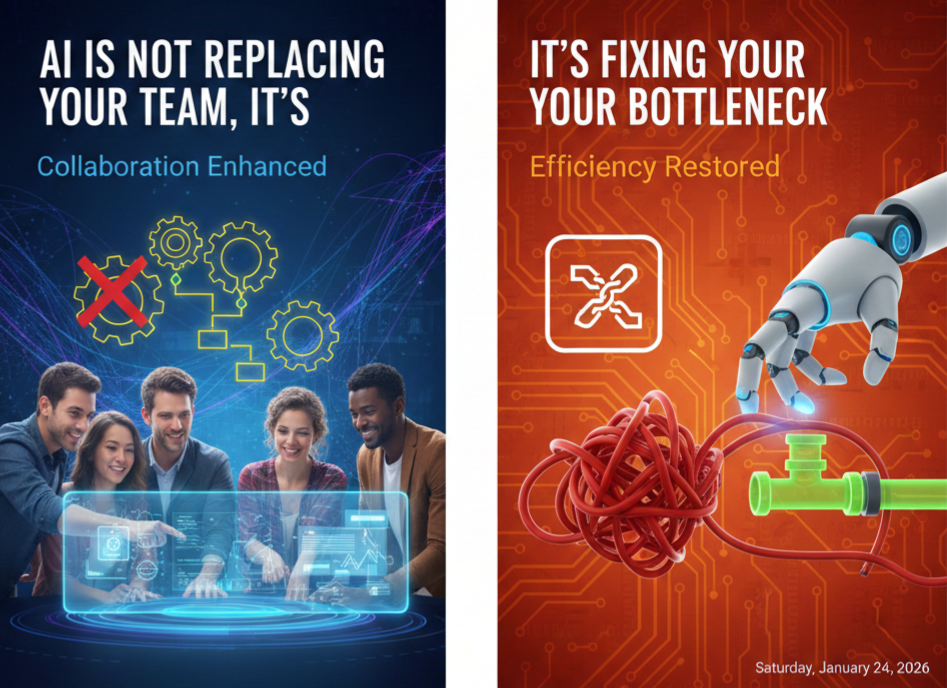
AI Is Not Replacing Your Team — It’s Fixing Your Bottlenecks
For the last couple of years, AI conversations have sounded extreme.
Either AI is going to replace everyone, or it’s just another buzzword.
In reality, most businesses aren’t struggling because they lack people.
They’re struggling because their teams are stuck doing manual, repetitive, low-value work.
That’s where AI actually fits in.
Not as a replacement for your team —
but as a way to fix the bottlenecks slowing your business down.
The Real Problem Isn’t Talent — It’s Friction
Most growing businesses face the same silent issues. Leads come in, but follow-ups are delayed. Sales teams spend valuable time updating CRMs instead of selling. Data gets scattered across spreadsheets, tools, and inboxes, while important insights remain buried under manual reporting. Even simple tasks require constant human intervention. None of these problems are caused by a lack of talent or effort. They don’t need more people — they need better systems. This is where AI quietly does its best work.

What AI Is Actually Good At (In the Real World)
AI performs best when it is applied to tasks that are repetitive, time-sensitive, rule-based, and data-heavy. In real business environments, this often translates into very practical use cases rather than futuristic promises.
1. Faster Lead Handling
AI can instantly capture, qualify, and route leads the moment they come in — instead of waiting for someone to check an inbox.
2. Smarter Follow-Ups
AI-assisted workflows ensure no lead goes cold because someone “forgot to follow up”.
3. Cleaner CRMs
Instead of sales teams manually updating records, AI can log interactions, update statuses, and keep data usable.
4. Better Visibility
AI can summarise performance, highlight drop-offs, and surface patterns humans miss when buried in dashboards.
The result?
Your team spends less time maintaining systems and more time using them.
What AI Should Not Be Used For
This is where many businesses go wrong. AI is not meant to replace decision-makers, handle sensitive customer conversations without oversight, be implemented without context or controls, or run everything autonomously. When AI is applied without structure, it creates more chaos rather than reducing it. The most successful implementations treat AI as support, not control.
The Right Way to Start with AI (Without Overhauling Everything)
You don’t need to go all-in on AI to see real value. A smarter approach starts with identifying a single bottleneck, such as delayed lead follow-ups, manual CRM updates, or slow reporting. That one process can then be automated using AI-assisted workflows rather than full replacements. The impact should be measured in practical terms, like faster response times, fewer missed leads, or cleaner data. Only once adoption is smooth and reliable should the system expand further. AI works best when it is introduced quietly and allowed to prove its value before growing.
AI as a Growth Multiplier, Not a Disruption
When implemented correctly, AI doesn’t radically change how teams work overnight. Instead, it removes delays, reduces manual effort, improves consistency, and creates breathing room for growth. People continue doing what they do best, while AI quietly removes the friction in between.
Final Thought
AI isn’t here to replace your team. It exists to fix the cracks in your processes, speed up what already works, and make growth easier to manage. The businesses winning with AI aren’t the loudest ones. They’re the ones using it quietly, practically, and intentionally.